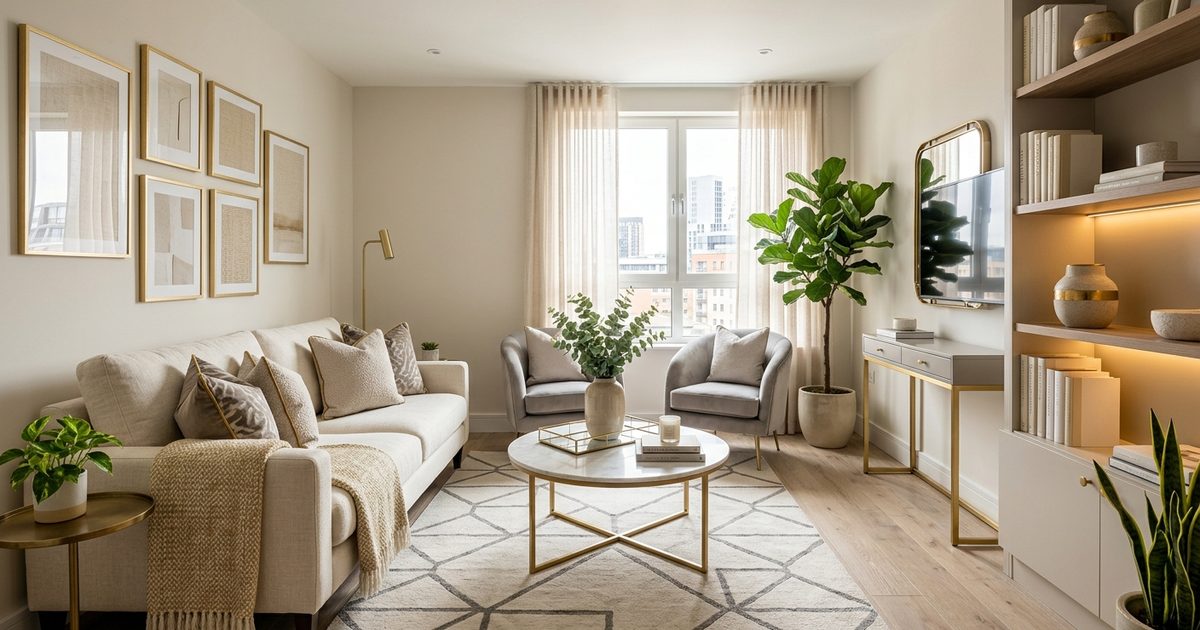
A small living room doesn't have to feel cramped or cheap. With strategic design choices and smart shopping, you can create a space that looks like it was styled by an interior designer — all on a modest budget. Here's how to make your small living room look luxurious for less.
Start With a Neutral Palette
Luxury interiors almost always use a neutral color palette — whites, creams, grays, and beiges. These colors make spaces feel larger, brighter, and more expensive. Paint is the cheapest way to transform a room, and a gallon of quality paint costs just $30-50.
Choose warm whites (like Sherwin Williams' Alabaster) over stark white — they feel more inviting and expensive. Add depth with textured fabrics like linen, bouclé, or velvet in the same color family.
Invest in Key Pieces
You don't need to spend a fortune on everything. Instead, invest in 2-3 key pieces that anchor the room and save on everything else. A quality sofa, a statement rug, and good lighting can elevate the entire space.
Look for secondhand quality furniture on Facebook Marketplace, OfferUp, or estate sales. A used high-quality sofa ($200-400) is far better than a new cheap one ($500) that'll sag in a year.
Budget Luxury Shopping Guide
Here's where to find luxury-looking pieces at budget prices:
| Item | Budget Option | Price Range | Luxury Look Tip |
|---|---|---|---|
| Sofa | IKEA Kivik + slipcover | $400-600 | Add a linen slipcover for custom look |
| Rug | Ruggable washable rugs | $100-300 | Layer over jute for depth |
| Coffee table | Thrifted + refinished | $30-100 | Paint or stain for custom finish |
| Curtains | IKEA Lenda + dye | $30-60 | Hang high & wide for luxury feel |
| Throw pillows | Amazon/Etsy covers | $15-25 each | Mix textures, not patterns |
| Lighting | Facebook Marketplace | $20-80 | Swap shades for instant upgrade |
| Wall art | Printable art frames | $20-50 | Frame large prints in thin black frames |
| Plants | Propagation + nursery pots | $5-30 | Use cache pots to hide plastic |
Space-Maximizing Tricks
Small rooms feel bigger with these design techniques:
- Hang curtains high and wide: Mount rods close to the ceiling and extend beyond the window frame — makes ceilings appear taller and windows larger
- Use a large rug: A rug that's too small makes a room feel smaller. Go as large as the space allows
- Mirror strategy: Place a large mirror opposite a window to double the light and visual space
- Float the furniture: Pull furniture away from walls — floating arrangements feel more intentional and spacious
- Scale up art: One large piece of art looks more expensive than a gallery wall of small prints
- Minimal surfaces: Keep coffee tables and shelves 70% empty — negative space reads as luxury
Lighting: The Secret Weapon
Lighting is the single most impactful element in interior design, and it's often the most neglected. A room with only overhead lighting will never feel luxurious.
Layer three types of lighting: ambient (overhead or floor lamp for general light), task (reading lamp), and accent (picture lights, LED strips). Use warm bulbs (2700K-3000K) — cool lighting feels institutional, warm lighting feels expensive.
Final Touches That Elevate
These small details make a big difference in how expensive a room looks:
- Style books: Stack books horizontally and vertically on shelves — use the spine color for visual rhythm
- Add metallic accents: Brass or gold objects (even cheap ones) add instant luxury
- Fresh flowers or branches: A $5 grocery store bouquet in a simple vase looks high-end
- Hide cords: Use cord covers or route behind furniture — visible cords kill the luxury vibe
- Steam wrinkles: Iron or steam curtain panels and slipcovers — wrinkles look cheap
- Edit ruthlessly: Remove anything that doesn't serve a purpose or bring joy
Article Was Generated By AI.
Comments (3)
Great article! Very helpful and well-written.
This is exactly what I was looking for. Bookmarking!
Amazing content as always. Keep it up!